Gas Town is a glimpse into the future
Around the same time I authored this post, Steve announced he was claiming tens of thousands of dollars in crypto currency from a meme coin based on Gas Town.
This post is about the Gas Town multi-agent orchestration project and its implications for future AI and engineering infrastructure.
I do not endorse or affiliate with this frankly bizarre twist.
When I first encountered Gas Town, I was already familiar with some of Steve Yegge’s work, especially his infamous 2011, accidentally public, Google memo. In it, Yegge recounted what Jeff Bezos had mandated at Amazon in 2002: every service from every team everywhere within Amazon must be exposed as an API. This mandate would eventually be what led to AWS’s emergence, invention, and market dominance. It’s no mistake that the AWS platform is the way it is because of this API and team service-oriented architecture.
Yegge said:
The Golden Rule of Platforms, “Eat Your Own Dogfood”, can be rephrased as “Start with a Platform, and Then Use it for Everything.” You can’t just bolt it on later. Certainly not easily at any rate – ask anyone who worked on platformizing MS Office. Or anyone who worked on platformizing Amazon. If you delay it, it’ll be ten times as much work as just doing it correctly up front. You can’t cheat.
Even before the commodification of the cloud, Kubernetes, containers, and platform engineering, Yegge had a keen understanding of where the industry had been, where it was, and the direction it was going. He knew that the “platform” was of the utmost importance for future business success and that bolting it on after the fact would be excruciatingly painful.
When Yegge launched Gas Town last week, a multi-agent harness backed by beads, his open source agentic “task” tracking system, it’s no surprise that the AI engineering world took notice. When Yegge peers into the future, he seems to have a unique perspective with a proven track record for seeing something the rest don’t.
Gas Town is intentionally esoteric: it’s very important to understand that this is by design. There are literal towns of agents with a Mayor to manage them, a “truth” observer called “The Witness”, Polecats who actually get things done, a god-like entity called the Observer (you) who hands the mayor mandates like Moses receiving commandments from Mount Sinai, Deacons for periodically telling Polecats to go and actually do their job, a Refinery where code can get merged properly as the many agents swarm to add their changes, and much more.
But upon using Gas Town, you start to see this vision that Yegge is trying to paint. You begin to understand the multi-agent “platform” that he is crafting and telling a story through. Like an art installation, Gas Town isn’t really meant to be used: it’s meant to change how you think.
Let’s look briefly at a feature I gave Gas Town to go and implement in a large private project I was working on: the code for this isn’t really that interesting. The process is. At a very high level, a Gas Town workflow involves you giving the Mayor something you want done. Then, it’ll dispatch all the agent workers to go and get it finished eventually producing a code artifact from the Refinery:
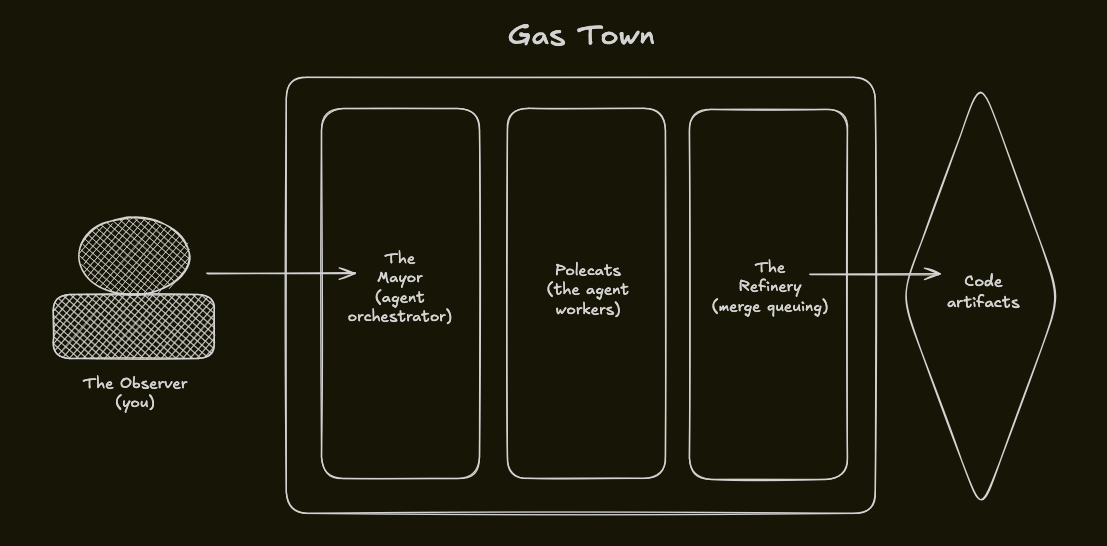
First, I rigged up the three code bases I knew that the agents would need: the core runtime, the admin dashboard, and the public API. This effectively clones the repos and adds them to the agent’s workspace (the Town).
gt rig add core git@github.com:org/core.git
gt rig add dashboard git@github.com:org/dashboard.git
gt rig add api git@github.com:org/api.git
Next, I attached to the Mayor session to tell it what I wanted it to do:
gt mayor attach> Inspect the public API
> and implement adding core runtime flags to accounts
> in the admin dashboard.
> I should be able to find an account and add a flag for that account.I knew that the agents would need to do a few things across these different code bases:
- inspect the shape of the public API in the
apirepo (this is where adding runtime flags for accounts actually happens and is supported by aPOST) and possibly add additional capabilities like aGETfor fetching all runtime flags. - inspect how runtime flags in the
corerepo actually work: these flags are specific to how individual accounts are configured and it’s very important context for actually using the API. - add the capabilities into the admin dashboard (i.e., understand how the Admin dashboard works, utilize the API, build the UI, implement the feature).
With that in mind, I let it loose!
Using Gas Town, there are moments where you think things have completely gone off the rails: at one point, I saw a Deacon scorn a Polecat for not being on task resulting in the Polecat throwing away its entire git worktree only to start over. The Mayor reported back to me that “Things have gone poorly” when that happened.
But eventually, without any additional prompting, the Mayor reported they had finished. I was surprised! I was able to actually get a pretty good result from this large multi-codebase setup: looking at the artifacts, I saw that a Polecat had opened a PR on the dashboard repo in GitHub, my team reviewed it, and we merged it through.
It’s very easy to look at Gas Town and blow it off as some fever dream, something that no serious engineer or organization would actually approve of using. It’s confusing, expensive, unsafe, and impractical. Further, you can probably get similar results by having a few tabs of Claude Code open and managing the context yourself.
But if we look at Gas Town not as a tool but a glimpse into the future, we start to see a very different story.
A story that tells us there’s a multi-agent future where coding, working, and delegating tasks looks wildly different from how it does today: hence its esoteric nature and naming. It’s much easier to tell an almost whimsical story about the future using Mayors, Towns, truth seekers, and gardens vs. workers, orchestrators, and merge queues.
Gas Town shows us that with a bit of bubble gum and duct tape (where all products, services, and infrastructure start!), you can get quite far orchestrating multiple agents to go and do large ambiguous tasks all while their context is being managed autonomously. Let’s not forget that just over a year ago Claude Code was first being released to the public! And practical, working multi-agent setups seemed infinitely far away!! Just getting single-agent systems to work was a miracle! Yet, here we are, despite how expensive it is, with a working multi-agent setup I can run locally!
The true innovation of Gas Town is that it takes what coding agents do really well, extends them,
and wrangles the necessary pieces for them to work together at the same time:
it bootstraps all the files, metadata, and repos for agents automatically
(which unsurprisingly reminds me a lot of brazil, the internal Amazon build and code management tool
that handles nearly all software dependencies within the company).
It also orchestrates the agent context and task management automatically through beads,
Yegge’s SQLite agentic task tracker.
All this without much human intervention.
It’s no surprise that Yegge picked the name Gas Town, a dystopian fictional place in the Mad Max universe where crude oil is turned to gas for vehicles and war machines. Essentially the only infrastructure remaining in a total wasteland.
If Gas Town convinces me of anything, it’s that we’re drastically lacking any kind of system for safety, governance, durability, compliance, or observability. Just like the lack of infrastructure in the Mad Max dystopia, Gas Town expects you to utilize its orchestration without a care for what’s happening, all run in Claude Code “unsafe” mode. It’s clear that multi-agent systems and orchestrators are right around the corner: but what happens when we don’t have the necessary telemetry, tools, or infrastructure to understand why these agents went off to do what they did? Furthermore, running Gas Town outside of a sandbox (which seems to be the way most people run it) opens your entire system up to potentially catastrophic consequences.
Ungoverned agent orchestration is a leaky abstraction. Any tool calls, file reads, reasoning blocks, or tasks completed by the agent are lost to the ether:
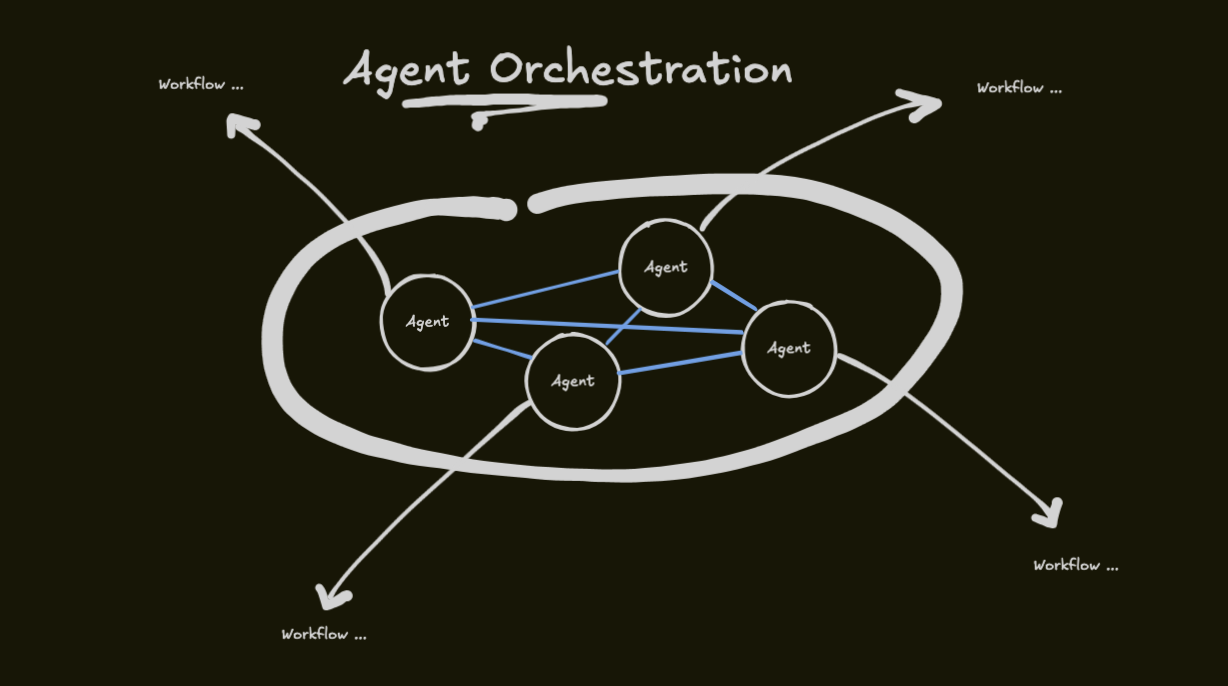
In reality, this is not really a multi-agent problem: we’ve yet to have good tooling for safely running, understanding, or governing single-threaded agents.
Gas Town just amplifies the problem.
It’s all fun and games when my Polecat nukes its own git worktree, but in the future, in a real production setting, when a multi-agent system, let alone a single agent system, decides to do something catastrophic that the original prompter did not foresee, what systems will be in place to monitor, understand, or catch the what and the why?
Gas Town is a glimpse into the future: a dark, grim future where we are still catching up on the tooling and infrastructure to support multi-agent workflows. With Gas Town, Yegge is showing us that the “platform” of multi-agent workloads and orchestration is nearly here. And without the tooling, observability, infrastructure, and services to handle that platform, bolting it on after the fact will be extremely painful.
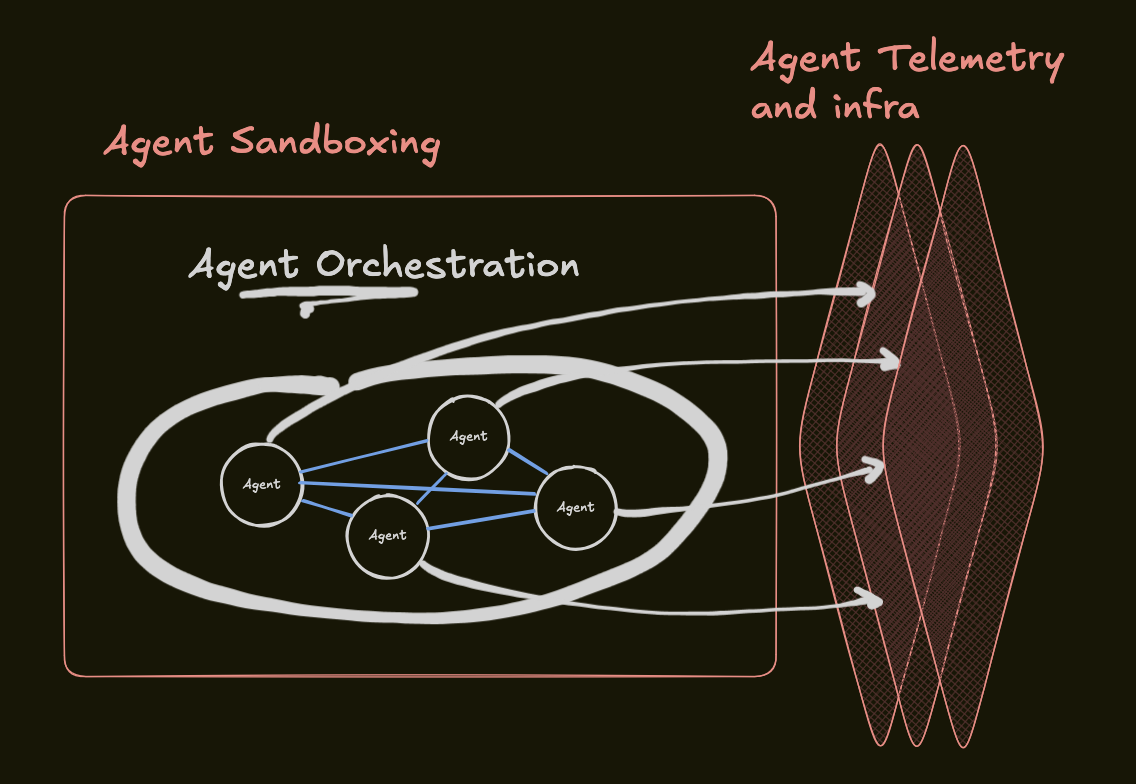
The multi-agent platform is nearly here. The infrastructure isn’t.
I plan to continue exploring agent telemetry, infrastructure, and tooling in my writing, so follow along here or on Bluesky. Much more to come.
Comments
Loading comments...